
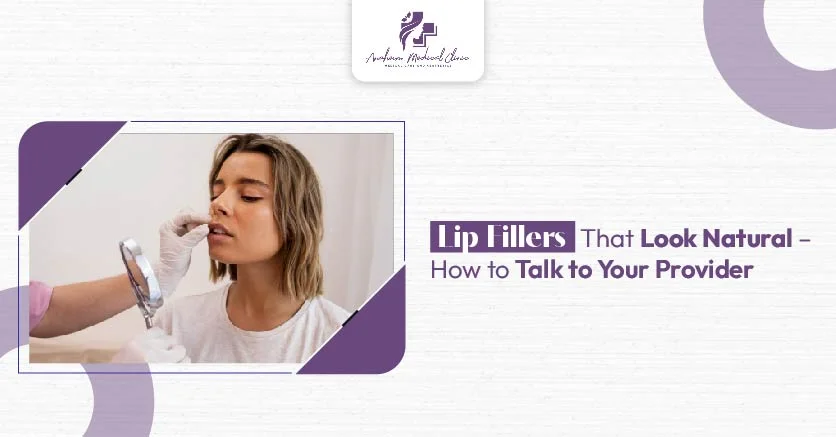
Nobody sits down in a consultation chair and asks for lips that look obviously done. Everyone says some version of the same thing. Fuller, softer, more defined, still mine.
And yet plenty of people leave disappointed anyway. Not because the filler itself failed, but because the conversation before the needle came out never actually covered what “natural” meant to that specific person.
Natural Means Something Different to Everyone
This is where things quietly go sideways. One person’s idea of natural is almost undetectable, just a little smoothing, nothing anyone would clock at a dinner party. Someone else pictures noticeably fuller lips that still move and look like real skin instead of something stiff and glossy.
Neither version is wrong. But walking into a consult and saying “just keep it natural” hands your injector almost nothing to work with. It sounds specific. It isn’t.
A better starting point is naming what you actually like about your lips right now, and what’s been bugging you. Thinness on one side. A cupid’s bow that’s gone flat. Lines creeping in around the edges. Bring a photo too, not someone else’s lips you want copied exactly, but something close to the fullness or shape you’re drawn to. That gives your provider an actual anchor instead of a guess.
Ask What Filler They’re Using and Why That One
Most lip fillers are built from hyaluronic acid, a substance your body makes on its own already, in your skin and joints. That’s a big part of why these results tend to settle in looking real. The filler isn’t foreign material sitting on top of your lip, it’s working with tissue your body already recognizes.
But hyaluronic acid isn’t one uniform product. Some formulas are cross-linked more densely, which makes them firmer, more structural. Others are looser and softer, made specifically to flex when you talk or smile instead of holding a stiff shape. A filler designed for cheeks or a jawline isn’t automatically the right call for lips, even if it’s technically in the same family of products.
So ask. Which filler, and why did you pick this one for me specifically. A provider with a real answer, something tied to your actual lip shape and goals, is doing this the right way. A provider who just says a brand name and moves on is worth a second question.
Bring Up Proportion, Not Just How Big You Want Them
A lot of people walk in thinking purely in terms of volume. More product, bigger lips. But that’s usually the exact mindset that leads to the overfilled look nobody actually wants.
Your face isn’t just your lips in a vacuum. The length of your philtrum, that stretch between your nose and upper lip, has a real effect on how much your upper lip can take before it starts pushing outward instead of just looking fuller. And what reads as balanced on one face can look exaggerated on another, using the identical amount of filler.
Ask your provider to actually talk through this with you. Not just how much filler, but how it’s going to sit against your natural shape, and how it’ll look when your face is moving, not just frozen in a mirror.
Just Say You’re Scared of Looking Overdone
If that fear is sitting in the back of your mind, say it out loud. Any decent provider has heard it a hundred times and won’t be thrown off by it. If anything, it tells them exactly what to prioritize.
This is also the moment to ask about going smaller first. A lot of experienced injectors will intentionally start conservative, with a follow-up appointment down the line once swelling’s fully gone and you can actually see the real result clearly. It’s a much easier position to be in, adding a little more later, than trying to undo something that went too far the first time.
And it’s completely fair to ask what happens if you hate it. Hyaluronic acid fillers can be dissolved, which is part of why they’re such a common starting point. Knowing there’s an undo button tends to make the whole thing feel a lot less nerve-wracking.
Ask About Technique, Not Just the Syringe
The product matters. Technique matters more, honestly. Hand two different injectors the exact same filler and you’ll often get two pretty different results, purely based on placement.
Ask whether they’re using a needle or a cannula, and why they lean toward one. Ask how they’re planning to spread the product across your lip instead of dumping it into one spot, since uneven distribution is usually the actual cause behind that lopsided, overfilled look people blame on the filler itself. And don’t feel awkward asking how much specific experience they have with lips. Injecting cheeks and injecting lips are not the same skill.
What It Sounds Like When You’re In Good Hands
You’ll usually be able to tell pretty quickly. Their answers sound specific to you – not like a script they run through with every client.
They don’t rush past your questions or seem irritated by them. And they’re honest about the timeline, that the first few days often look more swollen and dramatic than the final result, which usually settles somewhere around one to two weeks out.
A good consultation should feel like an actual back and forth, not something you’re being rushed through on the way to the injection.
Let’s Actually Talk Through What This Looks Like for You
Good lip filler results start with a real conversation, not a provider guessing at what you meant by “natural.”
At Anaheim Medical Clinic, that conversation is where everything starts — it’s built around your lips, your face and what you actually want to see when you look in the mirror. Reach out and let’s talk through it.