
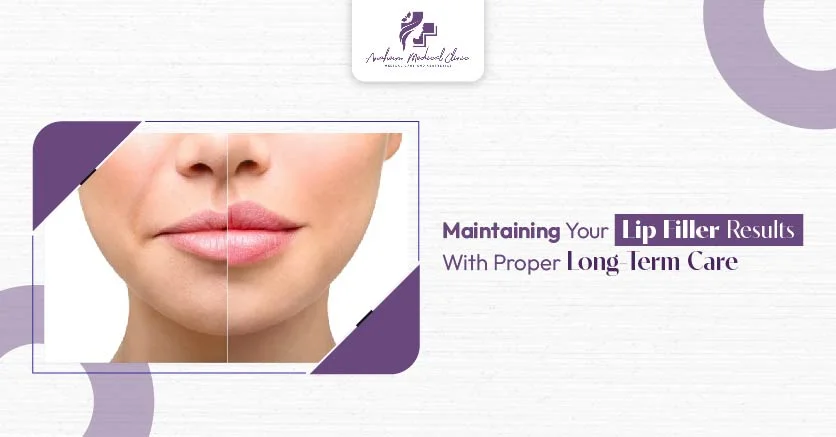
Lip fillers are not permanent.
The life of hyaluronic acid fillers varies significantly depending on the product – ranging from 6 months to 24 months.
To preserve the outcome, shield lips from the sun, avoid pressure initially, keep them moisturized and schedule appointments with an experienced injector for touch ups. If something feels off, call your provider immediately.
After day 3, most aftercare recommendations come to an end. That is all you need to know: Ice, no gym, no sauna. However, all that follows after the swelling subsides is what makes the difference in the appearance of your lips in month five.
Thus, both are covered in this guide. The first two weeks count and so does the long haul.
How long do lip fillers actually last?
It varies and is quite varied. According to an FDA clinical overview, approved HA fillers have a lifespan of approximately 6 months to 24 months, primarily due to the method of HA gel formation (crosslinking and molecular weight).
When considering a real lip fillers example, check out the patient info for one FDA-approved lip filler, Restylane Kysse. In its 12 months study:
- At 6 months 77% of people demonstrated improvement of at least 1 point in lip fullness.
- This reduced to 60% at 12 months.
- 78% still said their look has improved in 12 months.
So, results also gradually diminish. They don’t turn off. You also have a role to play and yours will differ from person to person.
What should you do in the first two weeks?
This stretch sets the tone. Here’s a timeline built from that same FDA patient information.
|
When |
What to Do |
|
Right away |
A cold, wrung-out cloth can help with swelling. |
|
First 6 hours |
Don’t touch the lips. They may be numb, and it’s easy to hurt them without noticing. After that, wash gently with soap and water. |
|
First 24 hours |
Skip hard workouts, extra heat, sun, and UV lamps. |
|
First week |
Avoid aspirin, ibuprofen and other NSAIDs, St. John’s Wort, blood thinners, and high-dose vitamin E, unless your provider says otherwise. |
|
Days 1 to 14 |
Mild swelling, tenderness, bruising, and lumps are common. Most side effects in the study lasted 7 days or less. |
|
Around week 4 |
If you need a touch-up, this is when the study placed them. |
A few providers also ask you to hold off on flying for about a week, since cabin pressure may worsen swelling. Ask yours.
What does long-term lip filler care look like?
Less dramatic than you’d think. Mostly it’s lip care and good habits.
- Protect your lips from the sun. Use a lip balm with SPF. UV is hard on lip skin, and sun is something the FDA patient information says to avoid right after treatment.
- Keep your lips moisturized. Dry, cracked lips look worse, filler or not.
- Stay hydrated. It’s good for your skin, even though no one has proven it stretches your filler’s lifespan.
- Be gentle early on. Heavy pressure and rough rubbing in the first days aren’t worth the risk.
- Tell your provider about other treatments. Laser, peels, and microneedling near the lips are worth a conversation first.
- Go to follow-ups. They’re how you catch lumps or asymmetry early.
What’s proven and what’s just popular?
You’ll read that stress, workouts, sugar, and cortisol all “melt” filler. Maybe some of that is true for some people. But those posts rarely cite a study, and neither of the main sources I checked mentions them.
Here’s the honest version:
|
Claim |
What We Actually Know |
|
The product matters most |
Supported. FDA says duration depends on how the filler is made. |
|
Individual bodies differ |
Supported. Results vary from person to person. |
|
Sun protection |
Sensible for lip skin. Not proven to extend filler. |
|
Cutting stress, sugar, or hard workouts |
Often claimed, rarely backed by evidence. Healthy habits are still good for you. |
|
Touch-ups every X months |
There’s no universal schedule. It depends on the product and how you look and feel. |
When should you get a touch-up?
Skip the calendar rule. Many people go back when they notice the shape fading, ideally before the filler is totally gone. Your injector can tell you what to expect for your specific product.
If your lips are fading unevenly, say so. That’s a normal reason to come in.
What’s normal, and when should you call?
Normal in the first couple of weeks:
- Swelling, tenderness, and bruising
- Redness and itching
- Small lumps you can feel
- Slight asymmetry while swelling settles
Call right away if you notice:
- Vision changes
- Signs of a stroke, like sudden speech trouble, a drooping face, or weakness
- Skin that turns white or blotchy
- Unusual pain during or after treatment
Call soon if you notice:
- Redness or swelling that persists longer than 14 days.
- Blisters, sores or a flare up of a cold sore
- Fever and/or spreading of redness, or drainage
- Pain away from the injection site
- Anything new that comes up weeks/months later
There are serious complications, although they are uncommon, such as damage to the tissue, loss of vision or stroke caused by the injection of the filler into a blood vessel, cautions the FDA. When in doubt, dial. Your provider may be able to break down hyaluronic acid filler with an enzyme called hyaluronidase, so inquire about this possibility.
Who shouldn’t get lip filler?
Product labels list some reasons to wait or skip it. For the lip filler above, they include:
- Pregnancy, breastfeeding or attempting to conceive
- History of severe allergies or allergy to lidocaine
- Any skin sores, rashes or infections around the lips that are active
- Take care of bleeding disorders, immune-suppressing treatment, thick scarring, or history of cold sores
Always tell your provider your full health history.
How do you choose a provider?
The FDA says filler should only be used by practitioners with appropriate training who know the relevant anatomy. Before you book, ask:
- What kind of training are you undergoing for the injectables?
- What is your favourite product and why?
- What would you do if I get a complication?
- Do you provide follow-ups?
Lip fillers at Anaheim Medical Clinic
Anaheim Medical Clinic offers lip fillers alongside other aesthetic and primary care services. The clinic is led by Dr. Victor Fayad.
Have questions about your results, or thinking about a first appointment?
- Book an appointment
- Contact us
- Call (714) 576-7575, Monday to Friday, 8 AM to 5 PM
- Visit 710 S Brookhurst St, Suite J, Anaheim, CA 92804
You can also read more about our team or browse the clinic blog.
FAQ
How long do lip fillers last?
This will vary depending on the product. The FDA has determined that approved hyaluronic acid fillers can last anywhere from 6 to 24 months. In one study on lip fillers, 60% had fullness that was improved at 12 months.
How to extend the lifespan of my lip fillers?
The two most important are the product and your own body! To back up your results, you need to take steps to protect, moisturize, attend follow-ups, and work with a trained injector to get your lips.
Can I use alcohol or exercise following lip fillers?
Steer clear of exercise and additional heat for the initial 24 hours, and consult with your provider about drinking alcohol. Some providers recommend that it be avoided for 24 hours or more.
Is it possible to dissolve lip filler?
This often can be reversed with hyaluronidase, a hyaluronic acid filler. Discuss with your provider before you make that decision.
When to be concerned about swelling or lumps?
Contact if swelling or redness persists beyond 14 days of time, or immediately for vision changes, white skin, severe pain or stroke symptoms.
This article is for general information and isn’t medical advice. Discuss your own care with a licensed provider.