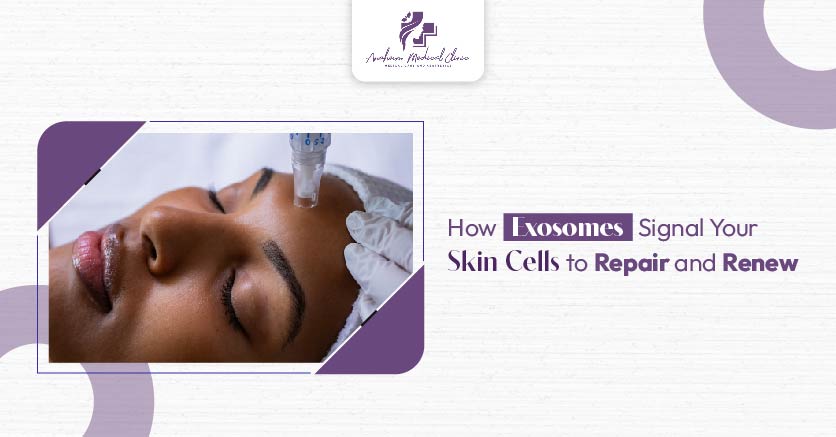
How Exosomes Signal Your Skin Cells to Repair and RenewExosomes are showing up everywhere. Clinic menus, skincare ads, your Instagram feed.The pitch is usually the same. Smoother skin. Fewer lines. A fresher face.But what are they? And do they really do any of that?Honestly, the science behind them is interesting. The proof is still thin. And the marketing is way ahead of both.Let’s sort out what’s what.
What Is an Exosome?
Your cells send stuff out all day. Exosomes are one of those things.They’re tiny bubbles. Way too small to see. Most are around 30 to 150 nanometers wide.Inside each one is a bit of cargo:
Proteins
Fats
Small pieces of genetic material called microRNA
Think of it like a note in a sealed envelope. One cell writes it. Another cell reads it.Your body already does this all the time. Exosomes aren’t new. What’s new is the idea of collecting them in a lab and using them in treatments.
How the Message Gets Passed Along
It’s a pretty simple chain.
A cell packs cargo into a small bubble.
It sends the bubble out.
A nearby cell takes it in.
The cargo changes how that cell acts.
That last step matters most. The message doesn’t just show up. It can tell the cell to do something different, like turning certain genes up or down.A review in Dermatology Practical & Conceptual explains that in skin, this kind of cell-to-cell talk helps keep tissue stable and working.
Which Skin Cells Are Listening?
Skin has layers. Each layer has its own cells with their own jobs. And each can pick up signals.
Cell TypeWhat It DoesWhat Exosome Signals May Affect (Lab Research)FibroblastsMake collagen and elastinGrowth and collagen outputKeratinocytesForm the outer layer and help it renewTurnover and wound closingMelanocytesMake pigmentPigment pathwaysImmune CellsRespond to injury and irritationInflammation
Notice the word “may.” Most of this comes from lab dishes, animal models, and small studies. That’s not the same as proof in large groups of people.
What the FDA Says
A lot of ads skip this part.The FDA regulates exosome products. According to its consumer alert, exosome products meant to treat diseases or conditions in people generally need FDA approval. And right now, there are no FDA-approved exosome products.In December 2019, the FDA also put out a public safety notification. Patients in Nebraska had serious problems after treatment with unapproved products marketed as containing exosomes. The agency also said that claims these products fall outside drug rules are untrue.That doesn’t mean all research is bad. It doesn’t mean every product is dangerous either.It does mean there are real unknowns. Things like how a product is made, stored, and handled.So if exosomes come up at an appointment, ask:
What exactly is this product?
Where does it come from?
What’s its regulatory status?
Has the FDA reviewed it, or is it part of a clinical trial?
What side effects should I watch for?
Who do I call if something goes wrong?
A good provider will answer straight. If the answers are vague, take note.
Promising vs. Proven
These two get mixed up a lot.
Promising
Lab studies suggest exosome signals can affect collagen, inflammation, and renewal
Researchers are testing different sources for skin aging and wound healing
People are working on ways to standardize how they’re made
Not settled yet
Whether products are consistent and safe from batch to batch
How long any visible change lasts
Who gets the most out of it
How they compare with treatments that have been around longer
If anyone guarantees results, that’s a red flag.
Who Might Want to Learn More
This isn’t a quiz. Only a provider who looks at your skin and health history can tell you what makes sense!
People who often ask about exosomes
Adults with fine lines, uneven texture or dull skin
People who’ve tried skincare and other treatments and wonder what’s next
Anyone who likes to understand the science first
People who should talk to a provider first
Anyone pregnant
Anyone nursing
Anyone with an active skin infection, rash or open wound in the treatment area
People with autoimmune conditions or on medication that affects the immune system
Anyone with a history of allergic reactions or slow healing
Anyone who isn’t sure what product is being offered
Common Myths
“Exosomes are stem cells.” Nope. They’re bubbles that cells release. Some come from stem cells, but the exosomes aren’t cells themselves.
“If the body makes it, it’s safe.” Your own exosomes are normal biology. A lab-processed product is a different story. Safety depends on how it’s made and handled.
“One treatment reverses aging.” Skin ages from sun, genes, smoking, sleep, and time. No single treatment cancels all that out.
“Everything online about exosomes is true.” A lot of it is marketing. Look for sources that name real studies and admit what’s unknown.
What You Can Do for Your Skin Right Now
Exosome research is still catching up. In the meantime, a few basics have solid support in dermatology:
Wear sunscreen every day
Don’t smoke
Use a gentle cleanser and a moisturizer that fits your skin
Get regular sleep, since skin does a lot of its repair overnight
Ask a provider what’s proven for your concerns
At Anaheim Medical Clinic, those talks can also include other aesthetic services like Matrix RF microneedling and skin boosters, depending on what you want to change.
FAQ
What are exosomes in skin care?
Tiny bubbles that cells release. They carry proteins and genetic material to other cells. In skin research, they’re studied for their possible effects on collagen, inflammation, and renewal.
How do exosomes signal skin cells?
A cell packs cargo into an exosome and sends it out. A nearby cell takes it in. The cargo can change how that cell behaves, like how much collagen it makes.
Are exosome treatments FDA-approved?
FDA has not yet approved any tissue exosome products. The agency has also issued warnings to patients about unapproved ones.
Is it safe?
That depends on the product, how it’s made, and how it’s handled. Ask about the source, regulatory status, and risks first.
What should I ask before treatment?
What the product is, where it comes from, whether it’s FDA-reviewed or part of a trial, what the risks are, and what results are realistic.
Talk It Over With Anaheim Medical Clinic
You don’t have to decide anything today. A conversation is a fine place to start.Anaheim Medical Clinic is led by Dr. Victor Fayad. He’s a board-certified internal medicine physician with 15 years of clinical experience and specialty in aesthetic care.In a consultation, you can:
Tell the team what bugs you about your skin
Ask every question from the list above
Hear what’s known, what isn’t, and what other options might fit
To get started, call (714) 576-7575.Bring your questions. You should walk out knowing more than when you walked in.Individual results may vary; treatment status is subject to response. This article is for informational purposes only and not medical advice!
Sources: